| brucekluger.com |

USA Today, July 13, 2000 Prying eyes still trail John Jr. By Bruce Kluger One year ago today, John F. Kennedy, Jr., the son of the slain U.S. President who went on to lead a celebrated life himself, ultimately launching the political magazine George, died in a private plane crash that also took his lives of his wife, Carolyn Bessette Kennedy, and her sister, Lauren Bessette. In the wake of the terrible events of that balmy summer weekend in
to put their personal spin on a life lived, crowding the editorial pages and TV news channels with recollections that ran the gamut from historical ruminations to locker room stories to a myriad of what-ifs—what if he entered politics, what if he never flew that plane, what if his mother was still alive?
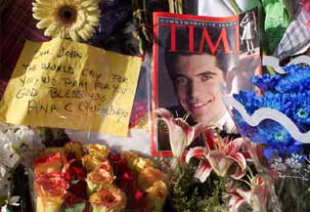
against the hazy backdrop of search planes combing the Martha’s Vineyard shoreline or telephoto views of the family’s Hyannisport compound seemed to agree on one thing: that although his life was over, the media circus that for nearly four decades had trailed him like a comet’s tail was sure to continue. Not surprisingly, that prediction held up, as stories about the handsome heir to Camelot continued to appear throughout this past year. His own magazine was the first to re-ignite the flame of his memory, publishing a special “Tribute Issue” in October 1999 that quietly replayed many of John’s better moments that had appeared in George. Then, by year’s end, his striking image— often tuxedoed, usually with his beautiful young wife on his arm—began reappearing on the cover of many publications’ holiday issues. It was almost as if we were confessing that, before we could move on to a new century, we needed to confirm one last time that the little boy who long ago saluted his father’s coffin and won a nation’s heart would not be able to make the trip with us. Unfortunately, though, as the new year began, so too did Kennedy-related discord. As a new editor took the reins of George, the interim editor vanished in a huff, only to resurface with a $750,000 contract with a major publishing company to write the definitive George memoir. (This in turn sparked infighting at the magazine, and resentment by former George staffers who upon hiring had been asked to sign confidentiality agreements about their famous boss.) Then came the tabloids, offering outrageous claims on everything from the state of John’s marriage at the time of his death, to his rumored inability to pilot his plane, to various lawsuits and liaisons that were as absurd as they were unconfirmed. Even the unremarkable Tribeca loft in which John and his wife lived together so briefly became fodder for quick-fix journalism, when daily papers followed the travails of actor Ed Burns as he faced off with the co-op board about purchasing the apartment. And as recently as this month, ripples continued to disturb John’s resting place in our memories when, on one hand, the National Transportation Safety Board confirmed that Kennedy had suffered a "spatial disorientation” that resulted in the fatal crash; and, on the other hand, the Star magazine promised the inside story on “JFK: The Wild Years.” Personally, I find it easiest—and least painful—to recall John in a professional light, which despite our congenial rapport was the basis of our association. As his editor on many of the celebrity interviews he conducted for George—from his first with George Wallace (October 1995), to his last, with Garth Brooks (April 1999)—I found this extraordinary man to be exactly what you’d expect from a world-famous “prince” who had the combined fearlessness and foolishness to decide to run a magazine with no previous experience: He was charming and confident, mischievous and smart—yet delightfully self-effacing. In a passage from the Brooks interview that was cut for space at the last minute, John revealed this endearing humility in a way that captures him best: BROOKS: When I'm trying to fit in where I don't belong, I'll mention [trendy] brand names of products, just to be cool with everybody. But the people who really know their stuff just look at you, and think, “Yeah, right.” They know you don't know what you’re talking about. KENNEDY: Yeah. That’s how I feel right here. |