


| brucekluger.com |

Time Out New York, December 16, 2004 Sympathy for the Devil Christmas might not be the best time to release a movie about a pedophile. But really, when is? According to The Woodsman director Nicole Kassell and stars Kevin Bacon and Kyra Sedgwick, there's no time like the present. By Bruce Kluger
Nicole Kassell are tucked into a wooden booth in the back room of the Chelsea pub, The Half King, deep in discussion about their new film, The Woodsman. As the conversation unfolds, the late-afternoon sunlight fades outside the windows. Oddly, no one thinks of turning on the lights, and before long, the trio is holding forth in the dark. And everyone is deadly serious. Such solemnity may hardly see
already been feted on the film-fest circuit and garnered a marquee's worth of critical superlatives. But in this case, sobriety is fitting. After all, The Woodsman is about pedophilia.
Kassell, 32, whose only other feature, The Green Hour, limned a similarly squirmy story line—one about a young wife and mother forced to choose between her family and another woman. Still, there's a world of difference between sexual confusion and sexual abuse, and Kassell—who's a new mother herself—chose the right performers to delve into this touchy topic. Already being touted by Oscar handicappers, Bacon's portrayal of Walter, a convicted child-molester who's looking for a fresh start after a stint in prison, pulses from the start with an unsettling blend of anger and mystery. Sedgwick's full-throttle turn as Vickie—Walter's hard-bitten but hopeful co-worker at the local lumberyard, and his eventual lover—matches Bacon's quiet ferocity frame for frame. Bacon, 46, and Sedgwick, 39, defy any existing model of the showbiz couple. Married 16 years, they have stubbornly eschewed the Hollywood Hills, choosing to live on Manhattan's Upper West Side, where they're raising two children. Bacon took a pass on guaranteed pop idolatry 20 years ago, by opting to follow his teen de force performance in Footloose, not with a string of like-minded films, but with a collection of smaller oddball roles. For her part, Sedgwick has assembled an eclectic career around what she says is her main priority—being a mother. TONY caught up with The Woodsman team early this month, as the three were gearing up for the film's Christmas Eve premiere—an admittedly odd choice of timing, given its less than festive subject matter. "I think," Sedgwick says, "that they call it counterprogramming." Time Out New York: I watched The Woodsman last night at home, and my wife, who ordinarily likes watching movies with me, didn't want to see it. She said it would make her too anxious. Kyra Sedgwick: And was she sorry when you told her about it the next day? So often I find that people who initially think, I don't want to watch that kind of movie, ultimately realize that it wasn't anything like they expected. They assume it's going to be graphic, or more difficult than it actually is. Kevin Bacon: That's one thing I think needs to be made clear about this film. When people hear about the story, they're afraid they're going to be seeing a movie in which bad things happen to children, that it's going to be voyeuristic and sensationalized. But that's not what happens. TONY: In fact, despite the genuine horror of pedophilia, 20 minutes into the movie we find ourselves pulling for Walter, a former child-molester who's just been paroled. In moviemaking terms, how do you accomplish this? Nicole Kassell: First and foremost by showing that he's a human being, and putting him in places that we can all relate to. Walter wants to have a normal life, whether it's going to work or watching baseball on TV. But the perception is that these people, even pedophiles, live in a totally different, warped world. That's not necessarily the case, and I think you can show this simply by making them human. This has always been an interest of mine. The Green Hour was about a mother who leaves her children, and that carries a huge stigma. She'll always be deemed a bad person for making that decision, so I tried to show what would lead someone to do something like this. In making The Woodsman, it wasn't so much about what led Walter to be a pedophile, but rather trying to understand whether he could change or be given a second chance. Bacon: Let me just add that I never set out to make Walter sympathetic. That's not actable. TONY: Sympathy isn't actable? Bacon: No. I can't walk through the door sympathetically. I can be angry. I can be hungry. I can be horny. I can be joyous. I can be stoned, drunk, whatever. But you can't act sympathetic. Sympathy comes from the receiver, which in this case is the audience. TONY: So then what does an actor do to make a former pedophile...endearing, for lack of a better word? Bacon: It's not even a matter of being endearing. It was never a question of my character trying to say, "Please, please like me." It was just about making him real. Walter is an unexceptional guy, except for the fact that he has this addiction. People who have Walter's problem are unrecognizable in a crowd. They don't drool; they don't have horns; there's not smoke coming out of their nostrils. And yet they're in our schools, our churches, riding on the bus next to us, they're even members of our families. I wanted to make Walter a regular guy—and also a sick guy who's trying to get well. That's all he's doing. He doesn't want to be the way he is. TONY: Still, the subject matter is extremely difficult. As parents, was it especially hard for you to visit such a dark place? Sedgwick: Pedophilia is a horrible thing. It's a sad, sick disease. But it exists. And it wouldn't be right to pretend it didn't, or to refuse to make a film about it, just because we want to believe such a horrible thing doesn't happen. You know, I raise my children consciously. I'm aware of what's going on in the world. And to me, as a society, we're only as sick as our secrets. If this movie can somehow start a dialogue—if it can get people talking about something that needs to be talked about; if it can give people some empathy toward the abuser as well as the abused—then that would be great. Besides, I'd rather play this character, or even Kevin's character, than play someone who blows away six people in a bar, which happens all the time in the movies. Bacon: Look, child abuse is swept under the rug. It's so much more widespread than we know about. According to the research, one in five girls is molested by someone before the age of 12. TONY: One in five? Bacon: One in five—conservatively. So yes, as a parent, I think that it's important to talk to our children about people who may harm them. But we also have to deal with the offenders as much as the children. The burden of responsibility cannot be put on kids to fix this problem. We have to look at the people in our lives who we possibly have suspicions about—a relative, a family friend—and reach out to them, confront them. And hopefully start to treat them. TONY: Nicole, was there a risk of overkill in making The Woodsman? Did you ever find yourself dangerously close to creating a movie that some might interpret as advocacy on behalf of poor, misunderstood pedophiles? Kassell: I don't think so. But there were a lot of pitfalls we had to be careful to avoid, such as implying that Walter would never offend again, or making any false promises. There's a very fine line between caring for this man and hating him. We were constantly aware that some people would be upset seeing Walter humanized, while others would feel sympathy toward him. TONY: Such as the moment when he asks his only real friend in the film, his brother-in-law, if he's ever felt any sexual urges about his own daughter. Walter poses the question so innocently, yet his brother-in-law nearly decks him. Bacon: That was a complex moment. It's one of Walter's big flaws. Because of his own history, he's always seeing his problem in other people, and in this scene, he feels like he needs to bring it up. It's a fuck-up, a mistake, something that he obviously shouldn't have said. He's also in denial, and that's a subtlety to the movie. When he gets out of prison, he believes that he's done the crime, done the time, and it's all behind him. He thinks his sessions with his court-appointed shrink are a fucking pain in the ass, and that he doesn't really need to go. He thinks he can go to work in the morning, come home, eat cereal, watch the ball game, get up the next day, go to work, on and on, and all will be fine. He even thinks he can live across the street from a schoolyard and that it's not going to be an issue. He hasn't accepted that there were victims of his crimes. That's one of the important things about his character: He thinks he's the victim. Sedgwick: And yet, throughout the course of Walter's journey, he comes to realize that he has hurt people. He begins to understand that there's something wrong with him, that he has to keep working hard to be normal—but that he'll never really be normal. And that, in a way, he'll be okay. TONY: Moving on, perfunctory sex question... Bacon: I like it. Sex. TONY: Duly noted. You and Kyra have some pretty vivid lovemaking scenes in The Woodsman, which naturally leads viewers to think about how you're a real-life married couple. You've said before that when you're doing a sex scene with Kyra onscreen, we're not seeing a snapshot of what goes on in your bedroom. Bacon: No, you're not. Let me say this about sex onscreen: Sex is a character study just like the dinner scene, the chase scene, the fight scene. Sedgwick: The crying scene. Bacon: The crying scene. They're all character studies, and you have to approach them that way. You have to ask, "What is the sex saying about these two people and their relationship with each other?" The first bed scene with Walter and Vickie, for example, is very specific. It's about Walter's sexual history and Vickie's sexual history. It's also the first time they've had sex, so right there, that's an acting exercise. I mean, in real life, Kyra and I have had sex, oh, at least six or seven times. [Laughter] Sedgwick: The feedback I've gotten from people about our scenes together—and I don't mean to toot my own horn—has been: "I forgot that you guys were married. Absolutely forgot." So that was a nice thing to hear—and if you could include that in this interview, that would be great. It'll show what good actors we are. Or I am. [Laughs] TONY: I'll see what I can do. Meantime, all three of you talk about hoping that people will come away from The Woodsman with a little more compassion for people like Walter. Do you suppose that some will say, "You're asking me to have sympathy for pedophiles? Now that's just going too far." Kassell: I think it's a broader thing than that. I always go back to the feeling I had when I first walked out of the play—the idea that, whenever some sort of villain is depicted in a media headline, there is always a human being and a history behind that story. I feel like the world would be a better place if we all took a moment to think beyond those headlines. There's so much fear factor and witch-hunting going on these days—and not a lot of sympathy going around. I think we could use a lot more sympathy. Sedgwick: For me, the word is empathy. We all have complicated histories. We are all capable of terrible things. We're all capable of miraculous things, too. And one of the most miraculous things is our ability to be empathic and compassionate with our fellow human beings. To understand and to give someone props for trying to get better. I have a lot of addicts in my life, and they'll never be well. They'll always be in recovery and struggling. But to me, that's a beautiful effort. They're struggling for redemption of some kind, and it's a beautiful thing when we can empathize with that struggle. I don't see The Woodsman as a movie that's trying to say, "Let's all feel sorry for the pedophile." I think it's bigger than that. I think it's about how we as human beings can learn to forgive. Bacon: You know, I don't know the answer to the problem of child molestation. But to pretend that it doesn't exist is definitely not the answer. To take your Catholic priests and shuffle them off to another town is not the answer. And so to have a movie like The Woodsman—which doesn't necessarily offer a definite answer, but at least puts the issue out on the table so that people leaving the theater can talk about it—is a good start. It's better to have a movie out there with no answers than to have no movie at all. |
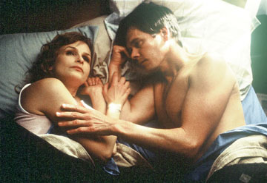
Mr. & Ms. Movie : Sedgwick, Bacon in The Woodsman.