| brucekluger.com |

The Chicago Tribune, September 27, 2006
Who really landed the final KO in the fiery Fox News face-off? By Bruce Kluger
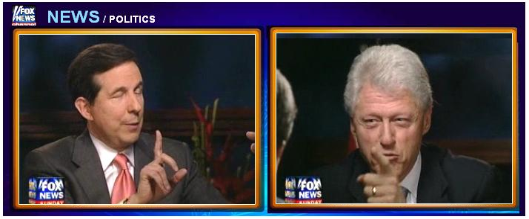
Channel last Sunday, pundits, politicians and a salivating army of miked-and-ready windbags had already meticulously sliced and diced the conversation to within an inch of its life, exercising the kind of analytic fervor customarily reserved for the text of a newly uncovered Gospel. Hardcore conservatives claimed that Clinton’s meltdown was carefully pre-planned and cagily calculated, a September Surprise-attack orchestrated solely to pump up his party while setting the stage for his wife’s come-hither run at the White House two years from now. Perennial presidential advisor David Gergen, meanwhile, couldn’t restrain a slight smile as he told CNN’s Anderson Cooper that Clinton’s touchiness was understandable, given Wallace’s insinuation that September 11 could be laid at his feet. Gergen also noted that Clinton’s performance in the Fox faceoff was just the kind of lesson in counterpunching that could inspire Democrats this campaign season. On The Daily Show, Jon Stewart rightfully mocked the media for focusing on the fireworks rather than reporting on the detailed information provided by Clinton during his upbraiding of Wallace. And over in the blogosphere, Arianna Huffington split the difference: Applauding Clinton for tossing obvious RNC talking points back into Wallace’s face, she also gave the 42nd President a nice “it’s-about-time” jab in the ribs. “That bipartisan love-in he's been engaged in over the last several years,” wrote Huffington, “has resulted in jack-squat.” And yet for all the chirping chatter about the unexpected Foxfire—which arguably edged out the NFL and Major League Baseball for the weekend’s best sporting event—I have yet to hear one analysis of the encounter that zeroes in on perhaps the two most important words spoken by President Clinton during his coast-to-coast dress-down of Wallace: “I failed.” No less than three times during the ten-minute squabble, Bill Clinton candidly acknowledged his unsuccessful attempts to capture or kill Osama bin Laden and pull the plug on Al Qaeda during his presidency, each time underscoring his sworn responsibility to have done so, and his deep regret at having not succeeded. “I tried and I failed to get bin Laden,” he told Wallace a third time, his words unencumbered by either sanctimony or spin. “I regret it. But I did try. And I did everything I thought I responsibly could.” This is why Bill Clinton left office with a 66 percent approval rating (higher than that of any departing president since such polling began) and now commands the world stage like a rock star. It is also why our current president’s numbers are sinking faster than a wagon wheel stuck in Texas mud. When it comes to American presidents, history has proven time and again that the strongest leaders are those who cop to their weakest moments. Harry S. Truman kept a famous sign on his desk—“The Buck Stops Here”—as a reminder to all who visited that he would not duck accountability for whatever his presidency produced. Despite his mistakes (his unauthorized invasion of Korea, his support of the Communist witch hunts—take your pick), this is what earned the plain-spoken haberdasher from Missouri his legacy as one of our greatest presidents. A decade later, John F. Kennedy held a news conference within days of the botched Bay of Pigs invasion, taking full responsibility for the fiasco. This candid contrition not only sparked a skyrocket in Kennedy’s poll numbers, but it also earned him the respect and authority he’d need 18 months later, when he carefully steered the nation through the touch-and-go Cuban Missile Crisis. Then there was Ronald Reagan in 1987, who after a few false starts ultimately took a pass on the “I am not a crook” option of his Republican predecessor and sucked up the blame for the convoluted Iran-Contra mess. The guy wound up on a stamp. And, yes, despite his initial—and notorious—finger-wagging denial of the Monica Lewinsky debacle, Bill Clinton eventually begged the nation’s forgiveness for his lies and lapses (some say ad nauseam) and the country lapped it up. America loves its reformed sinners, and it’s no accident that Clinton achieved the highest approval rating of his eight-year presidency—73 percent—directly after his impeachment. By contrast, George W. Bush continues to pass the buck. Not once in six years has this president looked the nation squarely in its eye and, without mitigation or fuzzy language or manufactured sound bites, plainly uttered the words, “I failed.” Not with Abu Ghraib. Not with Katrina. Not with Iraq. This is why Bill Clinton’s clash with Chris Wallace last weekend was so inspiring. Not because of the long-overdue payback to the relentlessly partisan Fox News (which was admittedly gratifying), nor the way the unexpected spat spiced up an otherwise boring night at the tube. But, rather, because amid the poking and prodding, the raised eyebrows and clenched jaw, the man simply said he’d tried and failed—and that he was sorry. This is something that our current president has never had the courage to do. |