| brucekluger.com |

The Chicago Sun-Times, April 1, 2007
Newspaper editorial cartoonist are casualties of war in a post-9/11 world By Bruce Kluger
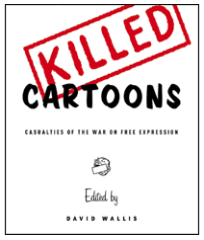
not? Even the wonkiest op-ed page addict eventually grows weary of all that purple-prose posturing and windy opinionating. And besides, with the constant stream of headache-inducing stories pouring in from the Middle East, the halls of Congress and the campaign stump, who couldn't use a swift jab to the funny bone every now and then? But according to the new book, Killed Cartoons: Casualties from the War on Free Expression (W.W. Norton), the business of editorial cartooning isn't exactly a laughing matter. A bracing collection of nearly 100 cartoons and drawings that were spiked by newspaper editors prior to publication, Killed Cartoons argues that the quick- drawing, quick-witted editorial cartoonist may be an endangered species. Much of this, says the book, is due to economics. Since 1975, about two-thirds of the nation's independent dailies have either folded or been consumed by corporate conglomerates, and the national roster of staff cartoonists has been slashed by more than half. But Killed Cartoons is less concerned with the dwindling number of Picasso-pundits scratching the day away at their sketch pads than it is with an even more pressing concern: the motivation of those who dictate whether a drawing flies or dies. Editorial cartooning, like any art form, is subject to the eye of the beholder; and in most cases, that beholder is an editor who has to decide if an image is overly caustic, gratuitously offensive, possibly libelous or just too plain racy for mom-and- pop consumption. But increasingly, the book contends, other criteria come onto play—standards that are, at best, fuzzy and subjective, and at worst, downright worrisome. "Certainly cartoon editors play the important role of gatekeeper," says David Wallis, who compiled Killed Cartoons and wrote the accompanying text. "They make sure that creative types do not flout journalistic ethics, break libel laws or put off readers and advertisers. But many of the cartoons in this book show in a naked way that taste is not always the issue. Politics is—and that's where we have a problem." To support his argument, Wallis includes first-person accounts by the artists, who reveal the kind of overbearing oversight that rendered their renderings unacceptable. These are not the kind of loony rants about "the mainstream media" that clog the blogosphere, but rather measured, almost resigned, confessionals by professional visual journalists who have simply thrown their talented hands into the air. Nationally syndicated cartoonist Ted Rall blames newspaper management for being overly sensitive—even reactionary—to reader complaints. Award-winning artists Dennis Draughon and Doug Marlette reveal how incorporating a Christ image into a cartoon is the quickest way to get it eighty-sixed. R.J. Matson of the St. Louis Post- Dispatch describes the ripple effect that followed the controversial 2005 publication of drawings of Muhammad in the Danish newspaper, Jyllands Posten. And more than a few of the contributors to the book confirm that life at the drafting table has gotten a lot tougher in the post-9/11 era. In late 2001, for example, Steve Greenberg of the Marin Independent Journal submitted a cartoon that depicted the Statue of Liberty peering out from behind the bars of a national security lockup—only to have the drawing boomerang right back at him. Recalls Greenberg: "[My editor], like many Americans, apparently felt the country and the news media were somehow obliged to not be negative or divisive in a time of national crisis." Ordinarily I am wary about books like Killed Cartoons, if only because it's easy to cry censorship at what is actually reasonable editorial scrutiny. But we are not living in a reasonable time in the life of the media. Since as far back as 2002, when Bill Maher was summarily sacked by ABC-TV for making a pointed crack about the 9/11 attacks, news coverage and editorial commentary have been glaring at one another from across the room, and all too often, the latter has blinked first. And yet, if nothing else, Killed Cartoons is a marvel to look at. These are the images you never got to see: brilliant and biting drawings that, tucked into the cramped quarters of a single panel, manage to capture the kind of message that it takes your typical editorialist 600 words to conjure. (Present company included.) Like Peter Kuper's unsettling recreation of the familiar, hooded torture victim at Abu Ghraib, only now with his electrical wiring leading up a hill and directly into the White House. The New York Times took a pass on the illustration in 2004. Or Kirk Anderson's chilling drawing of a Vatican fireman rescuing a priest from a burning church, leaving a small boy stranded behind in a flame-framed window. The St. Paul Pioneer Press rejected this one in 2002, deciding that its publication would, according to Anderson, "rock the boat." Or Mike Luckovich's heartbreaking 2003 sketch of 37 flag-draped coffins spelling out the words "W LIED." Back in the glow of shock-and-awe, the cartoon was axed by the editors at Atlanta Journal-Constitution, who deemed it inappropriate. Luckovich remained unbowed, and continued to draw—and publish—like-minded anti-war images over the next five years, as the American body count mounted in Iraq. These efforts earned him a second Pulitzer Prize in 2006. Legendary cartoonist Pat Oliphant once said, "The job of the cartoonist is to be against the government...That's what we do, and if the newspapers don't back us up, there's not much future for political cartooning." Killed Cartoons reveals precisely what Oliphant was talking about—literally in black- and-white. It will also make you think twice about what you're seeing—and not seeing—in your morning paper. |